
Why Storm Mornings Reveal the Truth About Your Service Model
- Snow Mow and More Landscaping LLC

- Feb 27
- 4 min read
Storm mornings in Madison reveal whether your snow removal company runs on structure or chaos. Learn why route design and dispatch math determine who gets cleared first — and why it matters.

Madison Snow Removal Isn’t About Plows —
It’s About Route Architecture and Structured Dispatch
There is a moment every storm morning in Madison when the truth shows itself.
It’s quiet.
It’s dark.
And somewhere between 3:45 and 5:15 AM, companies either move with precision — or scramble.
Homeowners don’t see it.
They just see whether their driveway is cleared before work.
But behind that outcome is something far bigger than a plow blade.
It’s a service model.
The Lie Most People Believe About Snow Removal
Most homeowners assume snow removal in Madison is about:
• Equipment size
• Crew count
• How early someone “starts”
• Or how much they paid
It’s not.
It’s about route architecture.
And storm mornings expose it.

The Dispatch Equation Nobody Talks About
Let’s simplify this.
Every snow event has:
• A start time
• A snowfall rate
• A total accumulation
• A freeze/thaw pattern
Now add:
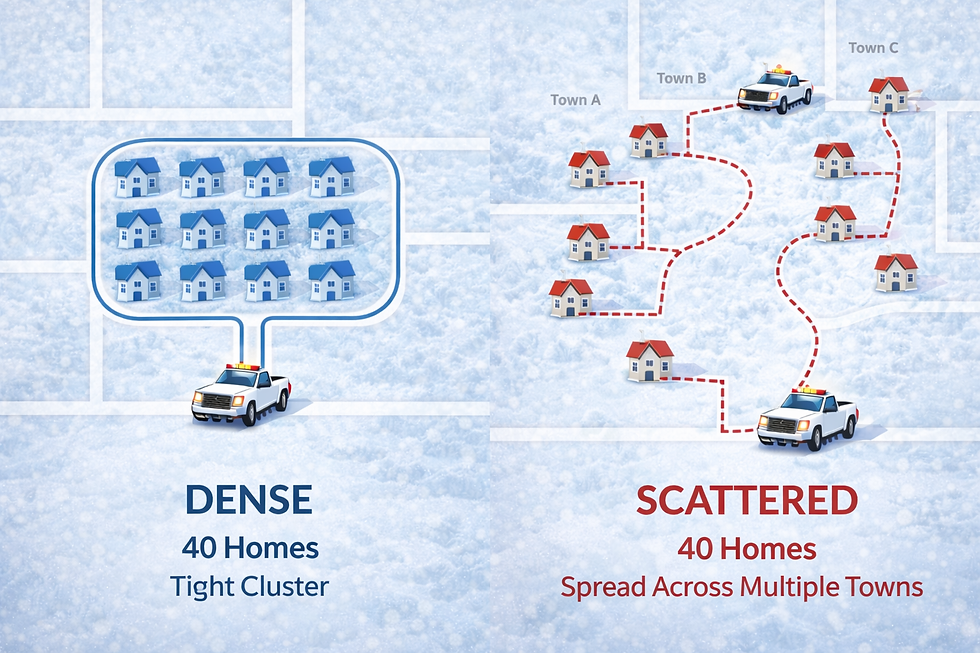
• 40 homes scattered across 5 zip codes
• 2 crews
• Variable driveway lengths
• Traffic conditions
• Equipment reload stops
If those homes are not clustered tightly together?
Everything slows.
Every extra 4-minute drive between houses compounds.
Every inefficient turn compounds.
Every reload compounds.
Snow doesn’t wait while trucks commute.
That’s the math.
What Happens in a Scattered Model
When a company sells one driveway here…
One driveway there…
Another five minutes away…
Storm mornings become reactionary.
Crews leapfrog neighborhoods.
Some homes get hit early.
Others get pushed later.
The order feels random.
Not because the crew is lazy.
Because the system is fractured.
And snow punishes fractured systems.
Why Density Wins Every Time
In a dense neighborhood cluster:
• Trucks move house-to-house in seconds
• No highway transitions
• No cross-town repositioning
• No wasted idle fuel
Momentum builds.
And momentum is everything in snow removal.
The tighter the cluster, the faster the completion window.
The faster the completion window, the less exposure to:
• Ice bonding
• Compaction
• Re-freeze
• Secondary accumulation
Structure reduces risk.
Storm Mornings Aren’t Emotional — They’re Mathematical
Homeowners often judge service based on:
“I saw another truck in my area first.”
But that other truck might:
• Have 6 houses on one street
• Be finishing a micro-cluster
• Be operating within a structured membership route
Meanwhile, scattered service models require constant transit.
And transit time is invisible — until you’re late.
The Compounding Effect of Route Design
Here’s what most companies won’t say:
If your house is an isolated job…
You are inherently less efficient to serve.
That means:
• Higher long-term cost
• Lower storm priority
• Increased variability
Not because someone dislikes you.
Because physics demands efficiency.
And efficiency dictates order.
Storm Psychology: Why Anxiety Spikes at 6:45 AM
Every storm morning has a tipping point.
6:30–7:00 AM.
That’s when:
• Commuters need to leave
• Schools announce delays
• Roads are partially cleared
• Anxiety spikes
In a structured route model, that window is anticipated.
In a scattered model, that window creates panic calls.
Structure absorbs stress.
Chaos amplifies it.

Snow Removal in Madison WI Is a Systems Game
Madison storms aren’t mild dustings.
We deal with:
• Lake-effect wind patterns
• Freeze-thaw swings
• Wet heavy snow events
• Overnight refreeze risk
A company built around reaction cannot consistently win those variables.
Only architecture can.
This Is Why Membership Models Exist
Structured route membership isn’t about contracts.
It’s about predictability.
When a company knows:
• Exactly how many homes are in a cluster
• Exactly where equipment is staged
• Exactly how long the loop takes
Storm mornings become controlled operations — not improvisation.
That is the difference between:
Service that feels random
and
Service that feels inevitable.
If you're researching professional snow removal in Madison, WI, the real question isn't just "who shows up?"
It's:
"Who operates on structure?"
And if you haven't read it yet, this connects directly to The Hidden Cost of Separate Lawn & Snow Services in Madison, where we break down why fragmented service models create instability long before a storm ever starts.
The Real Question
The next time snow falls, ask yourself:
Is your provider running a route…
Or chasing driveways?
Storm mornings reveal it.
Every time.
Where the Neighborhood Saver Plan Fits
The Neighborhood Saver Plan wasn’t built around plows.
It was built around density.
Around designing neighborhoods as structured clusters instead of scattered transactions.
Because when a neighborhood commits together:
• Routes tighten
• Completion windows shrink
• Variability drops
• Priority stabilizes
Snow becomes predictable.
Not because winter changes.
Because structure does.
If you want to see how the Neighborhood Saver Plan organizes routes in Madison neighborhoods, you can explore it here:
→ Neighborhood Saver Plan – Madison, WI (and surrounding)
Storm mornings don’t expose weather.
They expose design.



Comments